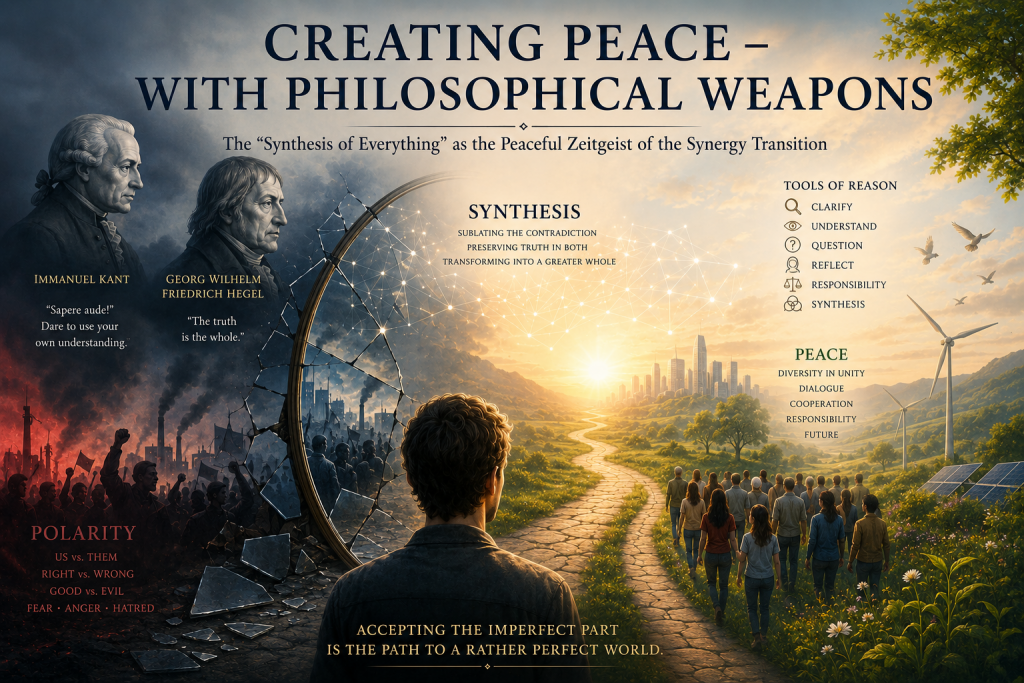
The “Synthesis of Everything” as the Peaceful Zeitgeist of the Synergy Transition
“The truth is the whole.” This sentence by Hegel could become the guiding principle of a new zeitgeist.
The past centuries have produced an extraordinary expansion of human knowledge. Science divides reality into ever smaller fields and develops increasingly sophisticated theories and models. Yet this very success has created a new problem: we know more and more about individual parts of reality without putting them back together into a whole.
This becomes particularly apparent in the social sciences. Market or state, freedom or equality, supply or demand, economy or ecology, conviction or responsibility: different perspectives are often treated as competing truths. When two statements contradict each other, we usually ask: Which one is true and which one is false?
Perhaps the mistake begins with the question itself.
Modern physics provides a striking example in wave-particle duality. Light and matter display properties that we describe with different classical concepts depending on the experimental arrangement. One description does not simply make the other false. Niels Bohr’s principle of complementarity takes this idea further: apparently contradictory descriptions can reveal different aspects of the same reality.
This is where we encounter Hegel. His thinking, too, opens the possibility of resolving a contradiction without one side winning and the other disappearing. In sublation, the truth contained in opposing sides can be preserved while their respective limitations are overcome.
For the Synergy Transition, this suggests a fundamental principle of knowledge:
When faced with a contradiction, do not first ask which side is true and which is false. Ask first on what level and under what conditions each of them is true.
A statement about a complex reality can be true on one level and false on another. Freedom can unleash human potential and restrict the freedom of others. Competition can generate innovation and concentration. Government action can restrict freedom while simultaneously protecting the conditions that make freedom possible. Centralisation and decentralisation, efficiency and redundancy, specialisation and diversity all have their strengths and weaknesses.
Contradiction itself is not the problem. The problem begins when a part is mistaken for the whole.
Accepting Imperfection
A second fundamental idea of the Synergy Transition follows almost inevitably. If theories, institutions and solutions reveal strengths under some conditions and weaknesses under others, then perhaps the search for the perfect part is itself a mistake.
Almost everything has a profile of strengths and weaknesses. This is not merely a deficiency. It is the precondition for synergy. Perfect parts would have no need for one another. Only imperfection makes it possible for the strength of one part to compensate for the weakness of another.
Accepting the imperfect part is the path towards a rather perfect world.
In technical systems, this way of thinking seems self-evident. We combine different materials, energy sources and processes precisely because none of them fulfils every requirement optimally.
With social questions, however, we find the same kind of thinking considerably more difficult. Different strengths and weaknesses quickly become moral opposites: right and wrong, good and evil, left and right. Once a position has been classified as morally wrong, it becomes difficult to look for whatever truth it may contain. And it becomes equally difficult to acknowledge weaknesses in a position we regard as right.
In doing so, we destroy the very precondition for synthesis.
Acceptance Begins in the Mirror
Accepting imperfection therefore begins by looking into the mirror.
Those who cannot accept their own imperfection will also struggle to tolerate imperfection in their convictions. We do not merely want to be right. We want to experience ourselves as being right. That is why we find it difficult to acknowledge the weaknesses of our own position – and equally difficult to recognise the strengths of a position we reject.
The more strongly a conviction becomes part of our identity, the harder it becomes to correct. Contradictions then do not necessarily lead to new insight, but to defensiveness, polarisation and further entrenchment.
This is where the Synergy Transition meets the problem described on menschversagen.de: reducing complex social reality to emotionally manageable opposites makes orientation easier, but obstructs precisely the synthesis that complex problems require.
Entrenched certainties often begin to crumble only when their contradictions can no longer be ignored. Crises can therefore force insights that previously seemed impossible. A rational society, however, should try to reach those insights before the crisis.
Those who accept imperfection in themselves no longer need to fight it in others, but can begin to look for its complement.
At this point, a method of gaining knowledge becomes an idea of peace.
The Truth Is Only the Whole
Hegel’s sentence thus acquires a particular significance for the Synergy Transition:
The truth is only the whole.
A partial truth is not false simply because it is incomplete. It becomes problematic when we mistake it for the whole. Knowledge therefore consists not only in producing new theories, but also in determining the scope of existing insights and combining their elements of truth into a more comprehensive picture.
This is where the Synergy Transition meets Paradoxology. Paradoxological Realism understands reality as the totality of everything that has an effect. This includes feedback loops, side effects, delayed consequences and relationships that we have not yet recognised.
Hegel’s sentence can therefore be given a crucial addition:
The truth is the whole. But the whole also includes what we cannot yet see.
Every synthesis therefore remains provisional. What appears to be the whole today may tomorrow reveal itself as merely part of an even larger context. The “Synthesis of Everything” does not mean claiming to know everything. It means always being prepared to discover that something is still missing.
Kant and the Task of Peace
Immanuel Kant provides a second great starting point. With “Sapere aude!” – Dare to use your own understanding he formulated one of the guiding ideas of the Enlightenment. With the categorical imperative, he also created a powerful foundation for universalist morality.
But Kant also explicitly addressed the question at the heart of the Synergy Transition: How can lasting peace be created?
In 1795 he published “Perpetual Peace: A Philosophical Sketch.” Peace, for Kant, was not something that simply arises by itself. He regarded relations between human beings and states as inherently exposed to the possibility of hostility; a genuine state of peace therefore had to be established and secured through law and institutions. Among other things, he developed the idea of a federation of free states and an international legal order.
More than two centuries later, the question remains.
The Synergy Transition begins one level earlier: What if peace need not begin only after opposing sides have emerged and must be restrained by institutions? What if we could learn to overcome polarity itself through synthesis?
Kant’s own ethics also demonstrates why clarifying levels matters. He took his ethics of duty so far that he rejected even a supposed right to lie to a murderer asking for the whereabouts of his intended victim. Moral principles were not simply to depend on the anticipated consequences of an action.
This reveals a more general problem:
The unconditional nature of a moral goal can turn into the supposed unconditional nature of the path chosen to reach that goal.
Anyone who questions that path can then quickly appear to be an opponent of the goal itself. Moral certainty can thus restrict precisely the free use of reason that Kant himself demanded.
Remarkably, Kant therefore provides us with both part of the problem and part of its solution: Use your own understanding.
Conviction for the Goals, Responsibility for the Means
Max Weber’s distinction between an ethics of conviction and an ethics of responsibility allows a synthesis at precisely this point:
The ethics of conviction determines the goals. The ethics of responsibility determines the means.
Human dignity, freedom, peace and the preservation of the natural foundations of life can remain unconditional humanistic goals.
But we must be free to think about the ways in which those goals can actually be achieved. Consequences must be considered, side effects examined, alternatives compared and mistakes corrected. If a well-intentioned course of action persistently produces the opposite of its intended goal, we must be able to change it.
An ethics of responsibility is therefore not a departure from morality. It assumes responsibility for ensuring that moral intentions lead, as far as possible, to their intended effects.
In the Hegelian sense, the ethics of conviction is not abolished but sublated: its truth is preserved while its limitation is complemented by another truth.
A New Tool of Reason
At this point something enters the picture that Kant, Hegel, Bohr and Weber could not have known.
No human being today can even approximately survey the totality of existing human knowledge. Still less can we simultaneously compare insights from physics, economics, psychology, history, ecology, sociology and philosophy. And the problem is not merely the quantity of knowledge. We have blind spots, emotional attachments and convictions that have become part of our identities.
Artificial intelligence does not eliminate these limitations. AI does not know the whole either, and it too can be wrong. But it can examine a vastly larger space of knowledge simultaneously and ask precisely the questions essential to synthesis:
On what level is a statement true? Where does its validity end? What are its strengths? What are its weaknesses? And which other insight complements precisely that weakness?
Kant’s Sapere aude thus acquires a new dimension in the twenty-first century. It does not mean handing our thinking over to machines. It could mean having the courage to extend our understanding with tools that help us recognise the limits of our own thinking.
And this is where a philosophical question becomes an existential one.
Creating Peace – with Philosophical Weapons
For war is the most extreme escalation of polarity.
It begins with division into opposites: right or wrong, good or evil, us or them. As long as each side can see only its own truth and its opposite in the other, disagreement becomes antagonism. Antagonism can become enmity – and enmity can ultimately become violence.
Synthesis follows the opposite logic. It does not attempt to resolve polarity by making one of its poles disappear.
War escalates polarity. Synthesis resolves polarity by sublating the elements of truth contained in opposing sides into a greater whole.
This does not mean glossing over every conflict or declaring every position equally right. Synthesis requires precisely the freedom to recognise strengths, weaknesses and limits. It requires neither sameness nor agreement. It requires a willingness not to search exclusively for what is wrong in the other.
The alternative is to resolve contradiction through the victory of one side. In social conflicts, this creates enemy images. Between states, the same logic can ultimately lead to violence.
The Synergy Transition therefore does not seek to defeat the opponent. It seeks to overcome the polarity from which opponents arise in the first place.
This is what is meant by:
Creating peace – with philosophical weapons.
It is not people who should be fought, but the patterns of thought that turn people into irreconcilable opponents. The “weapons” are clarification of levels, doubt, self-reflection, dialectics, responsibility and synthesis.
Kant searched for an order capable of making peace possible. Hegel showed a way of thinking in which contradiction need not be overcome by destroying one side, but by sublating it.
Perhaps we can bring the two together.
For peace once again begins by looking into the mirror:
Making peace with our own imperfection enables us to make peace with the imperfection of others.
Perhaps peace ultimately does not mean that our differences disappear.
Peace emerges when we learn to create syntheses from them.
Which End of History?
After the end of the Cold War, the “end of history” was proclaimed prematurely. The great struggle between political systems appeared to have been decided. Today we know that history did not end.
Yet we may indeed be approaching a historic crossroads.
Artificial intelligence expands our ability to bring knowledge together, analyse contradictions and reveal connections that were previously hidden from us. It could therefore become a tool for a new Enlightenment and a “Synthesis of Everything.”
Yet the same technology also expands the possibilities for surveillance, manipulation and warfare. Autonomous systems and artificial intelligence can accelerate military conflicts and reduce the space available for human decision-making. In a world of nuclear-armed states, it would be presumptuous to assume that an ever greater technological perfection of warfare will remain permanently controllable.
The same technology therefore presents us with two very different possibilities:
We can use artificial intelligence to overcome polarity through synthesis – or to perfect its escalation technologically.
Perhaps we are therefore facing two very different versions of an “end of history.”
The first would not be a perfect society. It would be the end of the idea that social progress must arise from one side defeating the other. Contradictions would remain, but accepting imperfection could enable an ongoing process of synthesis.
The other end would be far more literal.
If we perfect our technological means of fighting out human differences faster than our ability to synthesise those differences peacefully, we cannot simply assume that the history of our civilisation will continue indefinitely.
Perhaps the decisive challenge of our time is therefore, paradoxically, to stop trying to be perfect.
Not to create the perfect human being. Not to find the perfect ideology. Not to construct the ultimately correct society. And not to eliminate the part of the world that contradicts us.
Instead, we can recognise our own imperfection, tolerate the imperfection of others and use our respective strengths to create something better than its individual parts.
That could be the peaceful zeitgeist of the Synergy Transition:
Accepting the imperfect part is the path towards a rather perfect world.
And that acceptance begins by looking into the mirror.
Perhaps this will even determine which “end of history” lies ahead of us:
the synthesis of our differences – or, one day, the end of those who are fighting over them.
Schreibe einen Kommentar